


Hostile attitudes toward women are driving extremism in young Australians

A survey of Australians as young as 13 found misogyny can predict extremist violence more strongly than ideology, religion or time online

Published 16 August 2026
Students are funnelled into echo chambers, lured into extremist content through innocent avenues such as gaming and workout videos, then exposed to extreme misogyny, racism, homophobia and transphobia.
That's how one Australian teacher described what they're seeing in their classroom.

Andrew Tate's name came up again and again. Students cite the manosphere influencer – who is currently facing multiple criminal charges including rape and trafficking – as an authority in class discussions. Teachers found it hard to push back without being accused of bias.
Teachers call it the manosphere pipeline.
Our new national survey shows why it's so effective, and why it's more dangerous than any single extremist ideology, precisely because it doesn't lead just one way.
Our team surveyed 3429 Australians, including – for the first time in a study of this kind – teenagers as young as 13, about their opinions across six distinct extremist movements: incels, far-right, white supremacist, religious, far-left and anti-feminist extremisms.
We asked anonymised participants about their attitudes towards women, gender roles, violence against women, radicalisation and the use of violence for personal and political reasons.
Our survey asked whether they agreed or disagreed with statements like:
Sometimes women bother me just by being around.
The husband is the head of the household and the wife should be obedient to him.
In a relationship, a girl should give the guy what he wants sexually, even if she doesn’t feel like it at the time.
Feminism is a hate movement.
Across every single form of extremism we measured, the strongest predictor wasn’t political ideology, religion, ethnicity or how much time someone spent online.
It was hostility toward women.
This one attitude did more to separate those who support extremist violence from those who don't than every form of online engagement put together.
And it wasn’t a niche pattern confined to the ‘manosphere’.

If the same attitude predicts incel violence, religious extremism, far-right and white supremacist violence, and left-wing violence with almost equal force, then these aren't six separate radicalisation stories that happen to share a risk factor.
Misogyny is the ideological font from which they all draw.
Strip away the specific manifestos, grievances and enemies and what’s underneath, in every case, is the same belief system.
What they share is an ideology that men ought to dominate women, that transgression of the natural gender order deserves punishment and that violence in service of restoring the natural gender order is legitimate.
Extremist movements did not invent this logic from nowhere, though. They inherited it, already formed, from attitudes about gender that many of their recruits held before they ever found an ideology to attach it to.

Sciences & Technology
The importance of teaching boys about brilliant women
Our study was also interested in what online environments are most responsible for cultivating and amplifying both misogynistic attitudes and extremist attitudes.
National security agencies have focused heavily on gaming, online forums and social media. But once we accounted for what people believed about women, engagement with these platforms showed little independent link to extremist attitudes.
Three specific online environments stood out instead: manfluencer content, online dating platforms and pornography.
Manfluencer engagement was the single strongest predictor of misogyny in our entire dataset.
Online dating and pornography use were the two behaviours most tightly connected to attitudes that excuse violence against women.
These three forms of online content aren’t incidental features of online life. They are the most efficient producers of the exact attitudes that we found predict extremist violence.
When we dug deeper and tested whether these online spaces drive extremism directly, or only through the hostile gender attitudes they cultivate, nearly all of them lost their predictive power.
The danger, then, lies in what they teach people to believe about women, rather than any direct pull toward extremist ideology.
Pornography was the one exception. Even after we accounted for the misogyny it fosters, it kept a small but real direct link to extremist attitudes.
What’s perhaps most worrying is that this isn’t a story about adults radicalised in the dark corners of the internet.
Politics & Society
Are young men really becoming more conservative?
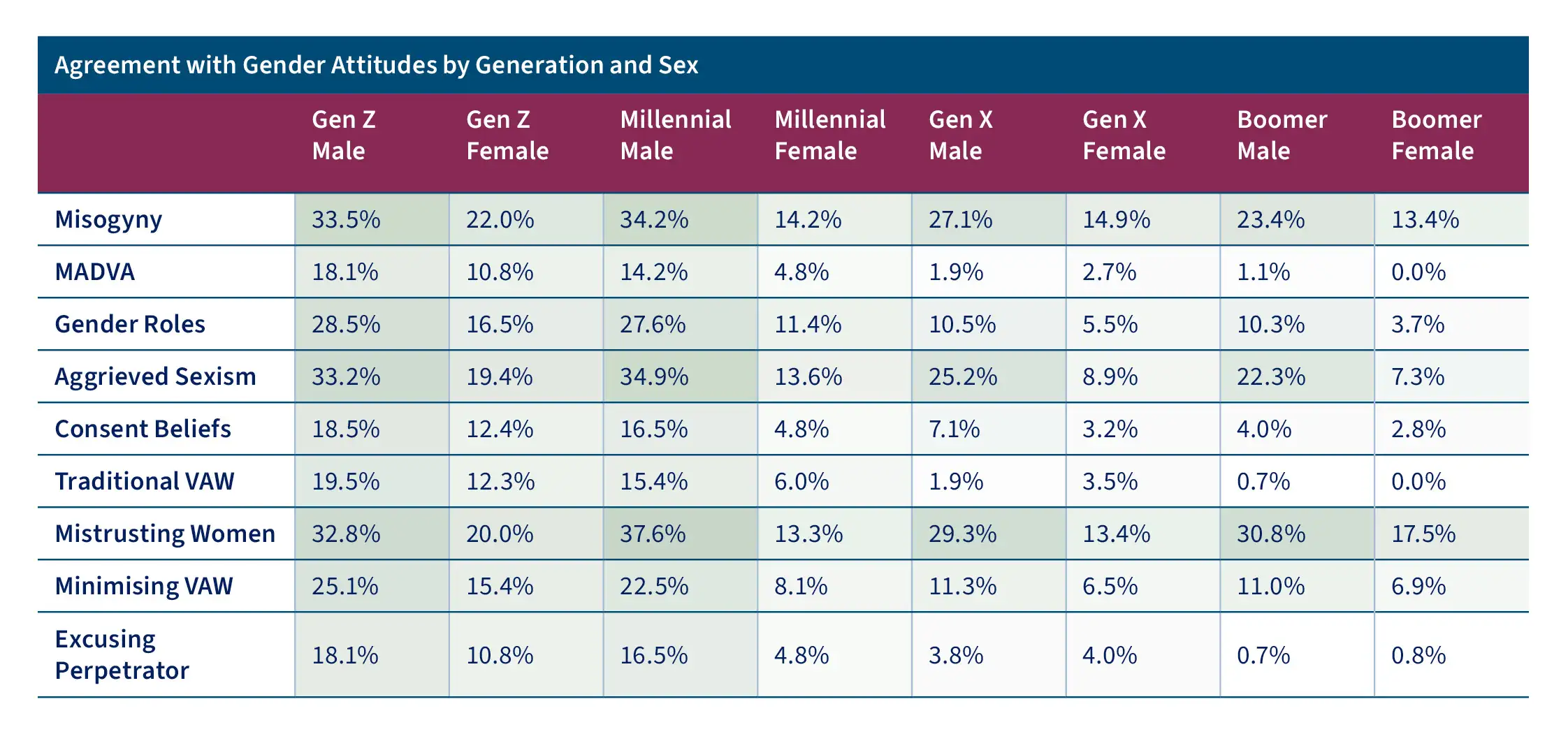
In our survey, teenage boys were the most likely to express misogynistic attitudes, mistrust of women and a belief in rigid traditional gender roles.
Teenaged girls were also surprisingly likely to express agreement with most of the same attitudes at much higher rates than adult women.
More than a quarter of teen boys also agreed with right-wing extremist statements, left-wing extremism and white supremacist violent ideologies.
One in four teenage boys agreed that feminism should be resisted with violence.
These attitudes are measurable well before the age at which most of our prevention efforts, including Australia’s recent under-16 social media restrictions, are designed to intervene.
This points to the gap in how Australia currently responds to these issues.

Our national security frameworks treat incel radicalisation, far-right extremism and religiously motivated violence as separate ideologies, studied by separate experts, requiring separate intervention strategies.
Our research suggests that they are not distinct but share a common root in misogynistic ideology.
Teachers already see this daily.
In our companion survey of 511 Australian teachers, 62 per cent flagged online misogyny as a concern in their own classrooms, and 57 per cent had personally observed students expressing anti-feminist views.
They also reported worrying levels of student support for tougher immigration policies, for violence against the government and for incel ideology.
A quarter of the teachers called out the manosphere influence as a problem in their classroom with 28 per cent saying misogyny was actively affecting their students’ wellbeing.
We had asked teachers about misogyny and extremism as separate things. But what they described, again and again, was one problem wearing different masks.
Currently, our efforts to curb the influence of harmful online content rest entirely on the social media delay policy which restricts access to certain platforms for Australians under 16.
Our research confirms that limiting children's exposure to algorithmically amplified harmful content is a reasonable step for government to take. But it's a blunt instrument, and it risks missing the forest for the trees.
Our findings point to a different kind of intervention, aimed not at screen time but at particular kinds of content, the material that carries the hostile gender attitudes so closely linked to extremism.

This calls for a more coordinated approach: intervening earlier on hostile gender attitudes and paying closer attention to what young people absorb about gender.
Misogyny and violent extremism aren’t parallel problems requiring parallel policy responses.
Treating the endorsement of violence against women as a matter of gender equity alone, rather than also a matter of national security, means we are missing a key part of the puzzle for understanding who becomes dangerous.
It also means we keep building policies, however well-intentioned, that protect against the platform instead of the poison running through it.
This research was funded by an Office of National Intelligence National Intelligence Postdoctoral Grant.