

How corals ‘breathe’ by stirring the ocean around them
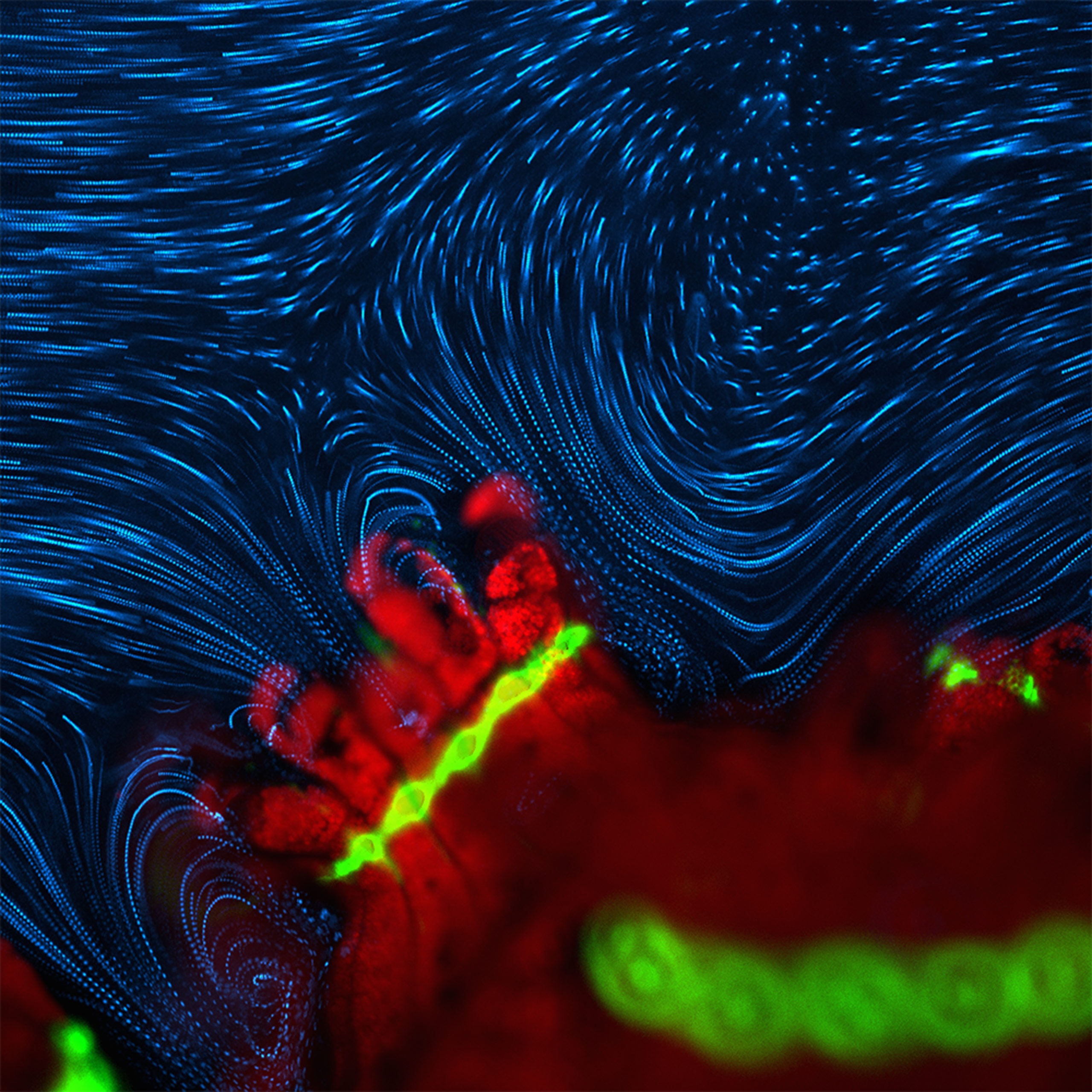
Tiny hair-like appendages on corals generate swirling microscopic currents – an ingenious way to exchange oxygen and nutrients with their surroundings

Published 27 May 2026
The Great Barrier Reef is the largest living structure on the planet – so vast it can be seen from space.
So how does this massive structure, sitting stationary in the ocean, manage to exchange sufficient nutrients and oxygen to survive and grow?

Despite the immense size of the reef itself, the processes that drive coral health – gathering nutrients, absorbing sunlight and expelling waste products – typically occur within 1 millimetre of the coral surface.
In the same way that a person’s lungs absorb oxygen and expel carbon dioxide, the surface of a coral is the primary interface for exchanging nutrients with the surrounding water.
However, this process can be very inefficient when the water is still, as chemicals tend to accumulate near the coral.
Our new research, now published in the journal PRX Life, shows how corals use an elegant solution.
Hair-like structures called cilia on the coral surface actively stir the surrounding water, creating three-dimensional microscopic flows.
Although cilia are only around 0.01 mm long – and several hundred times thinner than a human hair – collectively they create a striking array of mixing currents and cyclone-shaped vortices, which play a tremendous role in helping the coral tissue to exchange key nutrients with the ocean.
These small vortices – rotating regions of water in opposite directions – act like miniature merry-go-rounds, helping to shuttle material to and from the stationary coral surface.

Tiny paddles waving in the ocean
Our Melbourne research team, working with colleagues from the University of Manchester and the University of Copenhagen, conducted experiments on the Great Barrier Reef, developed a series of mathematical models and used lab-based imaging to study the intricate swirling currents created by corals themselves.
Although we knew corals could possess cilia and generate flows, it remained unclear how their precise arrangement and behaviour would stir the fluid in three dimensions and govern the exchange of food and oxygen.
We collected small fragments of the coral Porites lutea, sometimes known as 'stony coral', from the reef flat on Heron Island and brought these into the lab.
This coral is widely distributed in the Indo-Pacific region – from Australia to the Red Sea and Africa – and plays a key role in building the rocky substrate that forms entire reefs.
Environment
Restoring coral reefs by hedging our bets
In the same way that leaves blowing in the wind show how air is moving, we used suspended microscopic particles (0.005 mm in diameter) to visualise how the otherwise transparent water moves above the coral.
These currents are generated by the beating of many thousands of cilia on the surface, waving like tiny paddles.
Using a mathematical model that accurately recreates the fluid flows generated by each of these cilia, we were able to sum their effects and predict the overall flows created by the coral in three dimensions.
By tracking the movement of particles in flowing water, our mathematical model revealed that ciliary movements dramatically increase the rate at which coral exchanges nutrients – like oxygen and food particles – with its surroundings.
That is, the active flows enable the coral to ‘breathe’.
Following microscopic particles
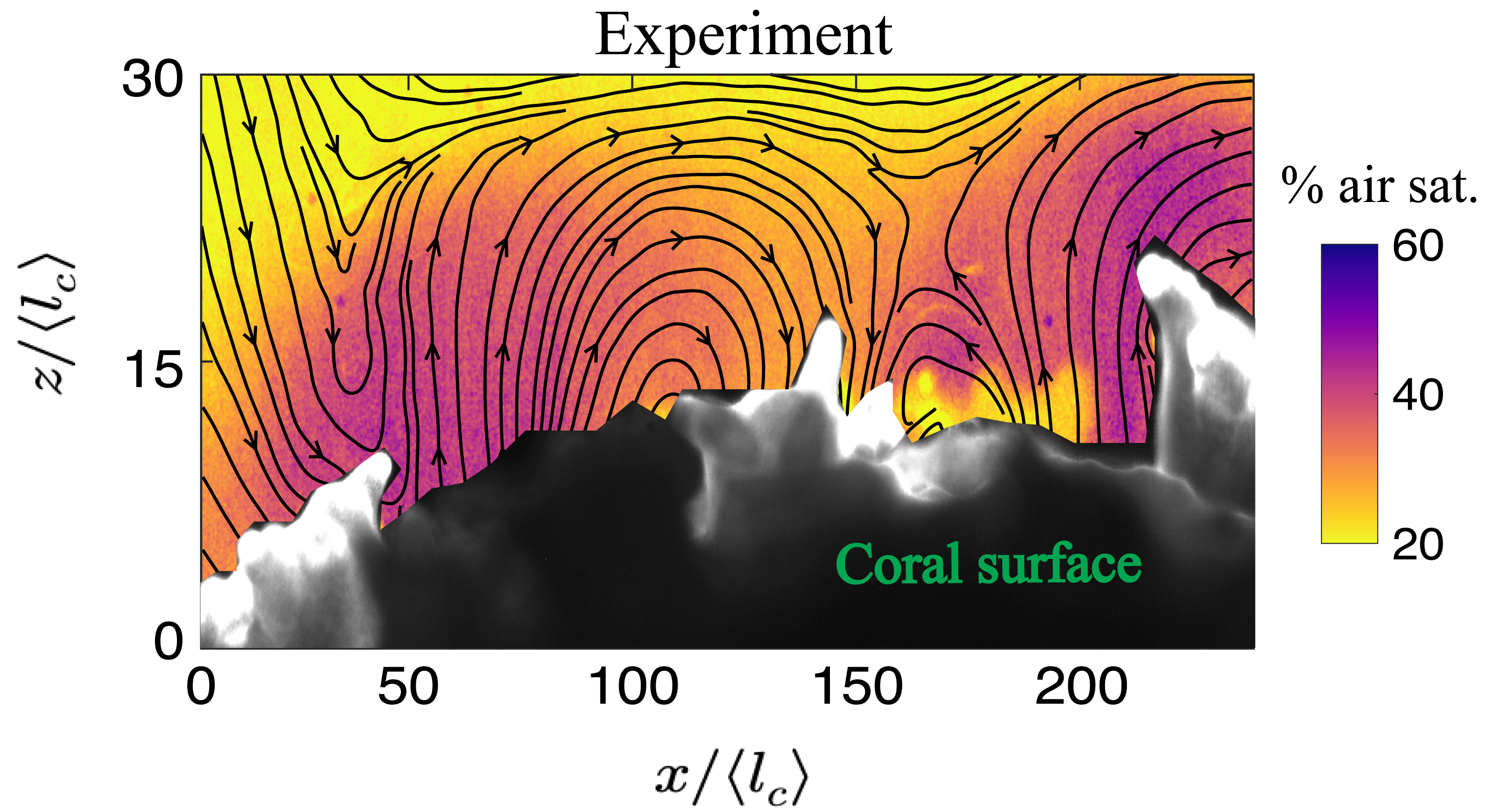
We repeated experiments using microscopic particles that change their brightness with oxygen concentration – brightest without oxygen and dimmer in its presence – to literally see how oxygen is transported in the water.
Under light conditions, our results reveal that ciliary flows bring in low-oxygen water (seen in image below). The flows collect oxygen from the surface of the coral tissue (produced by algal symbionts living within the coral), and then transport it into the water column.
Sciences & Technology
The mathematics of evolution
This process is like how a car engine prevents overheating by blowing cool air through it with a fan.
A major benefit of having a mathematical model to describe these flows is that our team can investigate processes that aren’t easy – or even possible – to measure experimentally.
We predicted how different types of particles would be transported, ranging from tiny molecules like dissolved gases to larger molecules and even plankton in the water.
We found that the transport is enhanced for all of these systems, but most pronounced for intermediate sizes.
Next, we extended our mathematical model to account for the fact that cilia are not all identically aligned across the surface.
Including natural variations, we measured a dramatic increase in the transport rate in our model.
This was most pronounced for nutrients with low diffusivity, like plankton and food particles, boosting their transport by more than 50 per cent.
Inevitable imperfections in cilia orientation turned out to be beneficial to the coral overall. For the purposes of aligning cilia, it seems that perfect really is the enemy of the good.
Sciences & Technology
Cleaner air is (inadvertently) harming the Great Barrier Reef
Warmer water makes cilia beat faster, until they can’t
In a complementary collaborative paper, this one led by the Copenhagen team, we investigated – again using experiments and mathematical modelling – how temperature changes affect the transport processes around reef-building corals.
The study revealed that in slightly warmer waters, the cilia start beating faster, thereby enhancing oxygen transport.
However, the coral's increased oxygen demand outstrips this supply, leading to low-oxygen zones within and around the coral tissue.
As the temperature increases further, ciliary beating – and subsequent active fluid flows – cease altogether, leading to coral death.

Coral bleaching and mortality have typically been attributed to the breakdown of partnerships between the coral animal and the algae living in its tissue.
This new study, however, points to a novel mechanism: impairment of ciliary flows leads to a collapse in nutrient transport and ultimately to coral death.
Beyond corals, our findings also shed light on how other organisms use cilia.
Examples included those in the human airway to sweep out dust and pathogens, in the fallopian tubes to potentially influence ovarian cancer, and in the transportation of messenger substances in the brain.
This also underscores the critical importance of processes occurring at millimetre length scales, and the outsized role they have in shaping the behaviour of larger organisms, and potentially entire ecosystems.

This work was led by Dr Siluvai Antony Selvan (Joint PhD scholar, University of Melbourne and University of Manchester) and Dr Cesar Pacherres (University of Copenhagen), as part of an international collaboration including teams from the University of Manchester (Dr Draga Pihler-Puzović, Professor Peter Duck) and University of Copenhagen (Professor Michael Kühl).
This research was supported by a Future Fellowship from the Australian Research Council (Associate Professor Brumley), two grants from the Gordon and Betty Moore Foundation (to Associate Professor Brumley and Professor Kühl), a joint PhD scholarship between the University of Melbourne and the University of Manchester (to Dr Selvan), and an EU MSCA fellowship (Dr Pacherres).
The coral fieldwork in this study was conducted under permit G24/49877.1, granted by the Great Barrier Reef Marine Parks Authority (to Prof. Kühl).