
Sciences & Technology
ADHD and autism are different, but on social media those differences are shrinking



The largest-ever study of mental health terminology shows how language has changed over 45 years, reflecting our changing attitudes toward mental illness and disability


Published 17 September 2026
How should we refer to people experiencing mental ill health or disability?
Ideally, the expressions we use are both apt and respectful. But too often the language of mental illness and disability has been pejorative and stigmatising.
Our new study explores how it has evolved and where we are now.
Preferred terminology has changed substantially in recent decades, but no consensus has emerged and preferences differ for different conditions.
Mindful of the importance of language, disability activists in the 1980s argued that common expressions like 'disabled person' or 'paraplegic' equated the person with their disability.
They advocated 'person-first' terminology as an alternative.
Referring to someone as a ‘person with disability’ puts the individual’s personhood in the foreground and doesn’t define them by their impairment.
Sciences & Technology
ADHD and autism are different, but on social media those differences are shrinking
Person-first language was soon adopted as preferred terminology by professional organisations in the disability and mental health fields. Guidelines for academic publishing and media reporting then followed.
More recently, there has been a backlash.
Critics argue that person-first language presents disability or mental illness as a devalued, unwanted and peripheral aspect of an individual’s identity. The American psychologist Professor Louis Sass expresses the sentiment beautifully:
"Is schizophrenia best conceptualized as a disease entity that comes, as it were, from outside, and with which the sufferer must contend, as with a burden or an enemy? Or is it better seen as a more intimate factor: something that emerges from within, permeates the very core of one’s being, and must, perhaps, be understood as an aspect of the sufferer’s very soul?"

Proponents of ‘identity-first’ language claim that expressions like ‘autistic person’ recognise that some conditions are not external visitations but integral aspects of the individual.
Identity-first language was endorsed by the American Psychological Association in 2020, and surveys indicate it is preferred by many neurodivergent people.
But how widely these contrasting approaches to terminology have been adopted remains poorly understood.
Does person-first or identity-first language dominate? Have preferences for them shifted over time? And do these preferences differ for different conditions?
Answers to these questions would clarify how the language of mental health and disability has evolved, and where it remains unsettled.
Health & Medicine
Do we think about anxiety and depression differently now?
Our recently published study presents the largest-ever investigation of mental health terminology.
We assessed the relative popularity of person-first and identity-first expressions for 15 mental health, disability and other conditions over a 45-year period.
We examined two vast English-language databases: the Google Books corpus (1980-2019) and the 23-billion-word global News on the Web corpus of newspapers and magazines (2010-2025).
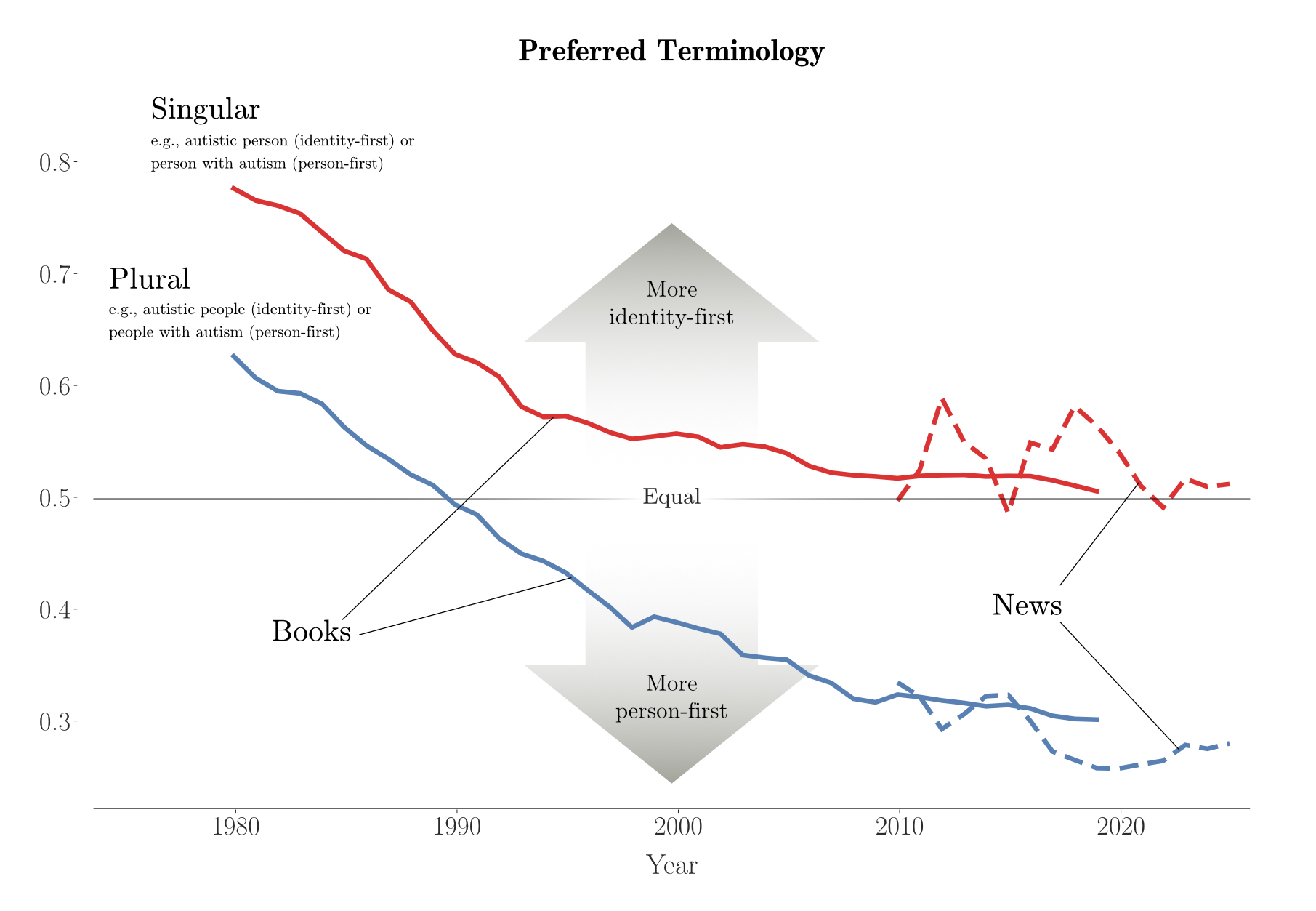
For each condition and year, we counted the frequency of four expressions: person-first or identity-first expressions for singular or plural targets.
For autism, for example, we counted ‘person with autism’, ‘autistic person’, ‘people with autism’ and ‘autistic people’.
Using these values we computed the relative popularity of person-first versus identity-first language when referring to individuals or groups.
Several trends became obvious from our results.
Identity-first language was dominant in the 1980s but steadily declined, presumably under the influence of person-first language advocacy.
This decline slowed in the 1990s, and preferences have not shifted meaningfully since 2010.
Although advocacy for identity-first language has increased, it has not yet produced a widespread preference for identity-first terminology in books and news media.

Health & Medicine
Knowing when to seek help for mental health
At most, it has contributed to arresting the adoption of person-first language driven by an earlier generation of advocates.
Whether terms refer to individuals or groups also matters.
When describing individuals, identity-first expressions have generally been more prevalent, though recently they have become roughly as popular as person-first expressions.
When describing groups, person-first expressions now predominate.
Mental health problems and disabilities are typically understood as aspects of personal identity more than group identity, so it is not surprising that identity-first language is more prevalent when referring to individuals.
It makes sense to use ‘psychotic person’ over ‘person with psychosis’ but also use ‘people with psychosis’ rather than ‘psychotic people’ if we see psychosis as a personal experience rather than a basis for collective identity.

These findings, based on averages, conceal large variations across our 15 conditions.
For example, identity-first language was consistently preferred for some conditions, like alcoholism, anxiety and obesity, and person-first language for others, like anorexia, bipolar, diabetes and epilepsy.
The conditions also show diverse patterns of change. In recent years, there has been a rise in identity-first terminology for autism and dyslexia, but an increase in person-first terminology for bipolar, anorexia and obesity.
These varied trends reveal the complexity of language about mental health, disability and related concepts.
Although we have seen a swing towards person-first expressions in past decades, and a more recent correction of that swing, trends in language are quite specific to the condition.
When we look at why predominant language trends depend on the condition, two key answers arise.
First, some conditions have become the focus of identity claims more than others.
The neurodiversity movement, for example, has promoted the view that neurodevelopmental conditions are inherent and valued aspects of the person rather than medical illnesses.
The increase we found in identity-first language for autism and dyslexia supports that.
More broadly, whether people favour identity-first or person-first language for different conditions may reflect our beliefs about whether they represent identities or attributes: who we are or what we have.

Some conditions – like neurodevelopmental conditions – are seen as biologically caused and enduring and are therefore more likely to be viewed as part of the person’s ‘true self’ than those seen as externally caused or transient.
Identity-first language should be especially appealing for the former.
The language we use in this domain is not a collection of inert labels. It is contentious and ever-changing, with many bodies offering recommendations.
Individuals and groups should have a say in how language evolves to represent them.
Paying attention to these changes can shine a light on our shifting values and beliefs about mental illness and disability.
If you or anyone you know needs help or support, please contact Lifeline on 13 11 14.