

Particle Physics

Sciences & Technology
Research
The secret history of Melbourne’s particle accelerators
With names like the Neutron Howitzer, MUVEC, and the Pelletron, Melbourne’s particle accelerators have been the hidden engines driving research for almost a century

Sciences & Technology
Research
Neutrinos are the Sun’s secret messengers
Once thought undetectable, huge underground experiments are unlocking the nature of ghostly particles called neutrinos, which could be the key to a deeper understanding of what is happening inside the Sun

Sciences & Technology
Dark matter might be ‘light’
We don’t know the mass of dark matter particles, so researchers are developing new techniques to look for new, lighter types

Health & Medicine
Everyone can help forge a safe ending to what Oppenheimer began
While no film can convey everything about nuclear weapons, Oppenheimer is a timely reminder of how fallible humans created the first weapons that could destroy our world

Sciences & Technology
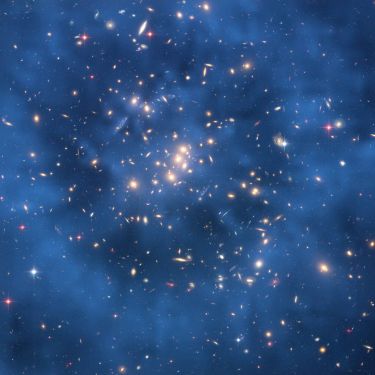
Digging deep for dark matter
A dark matter laboratory at the bottom of a gold mine in rural Victoria could make one of the biggest scientific discoveries ever – proving the existence of dark matter
Sciences & Technology
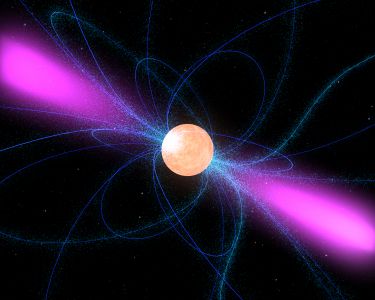
Using neutron stars to detect dark matter
The search for dark matter may need a detector larger than we can build on Earth, but it could be that a neutron star can do the job
Sciences & Technology
Podcasts
Catching sight of dark matter
This century, one the biggest challenges in fundamental physics will be to really understand the nature of dark matter, explains Professor of Physics Elisabetta Barberio

Sciences & Technology
Under the Microscope
The dark matter detective
High energy physicist Professor Elisabetta Barberio is leading groundbreaking Australian research in the hunt for dark matter and it’s all happening deep underground

Sciences & Technology
Podcasts
Honey I shrunk the particles!
Nanodyamics, super sponges and jumping out of a plane in the name of science
Sciences & Technology
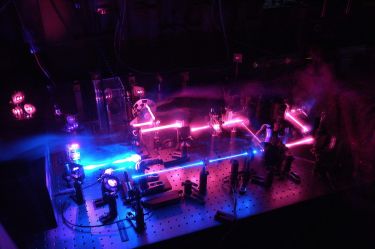
The exciting future of light energy
Excitons are formed when light is absorbed by electrons within a molecule, and we’re just beginning to understand the role they could play in meeting the world’s future energy needs