Sciences & Technology
A new thermometer for studying our past climate


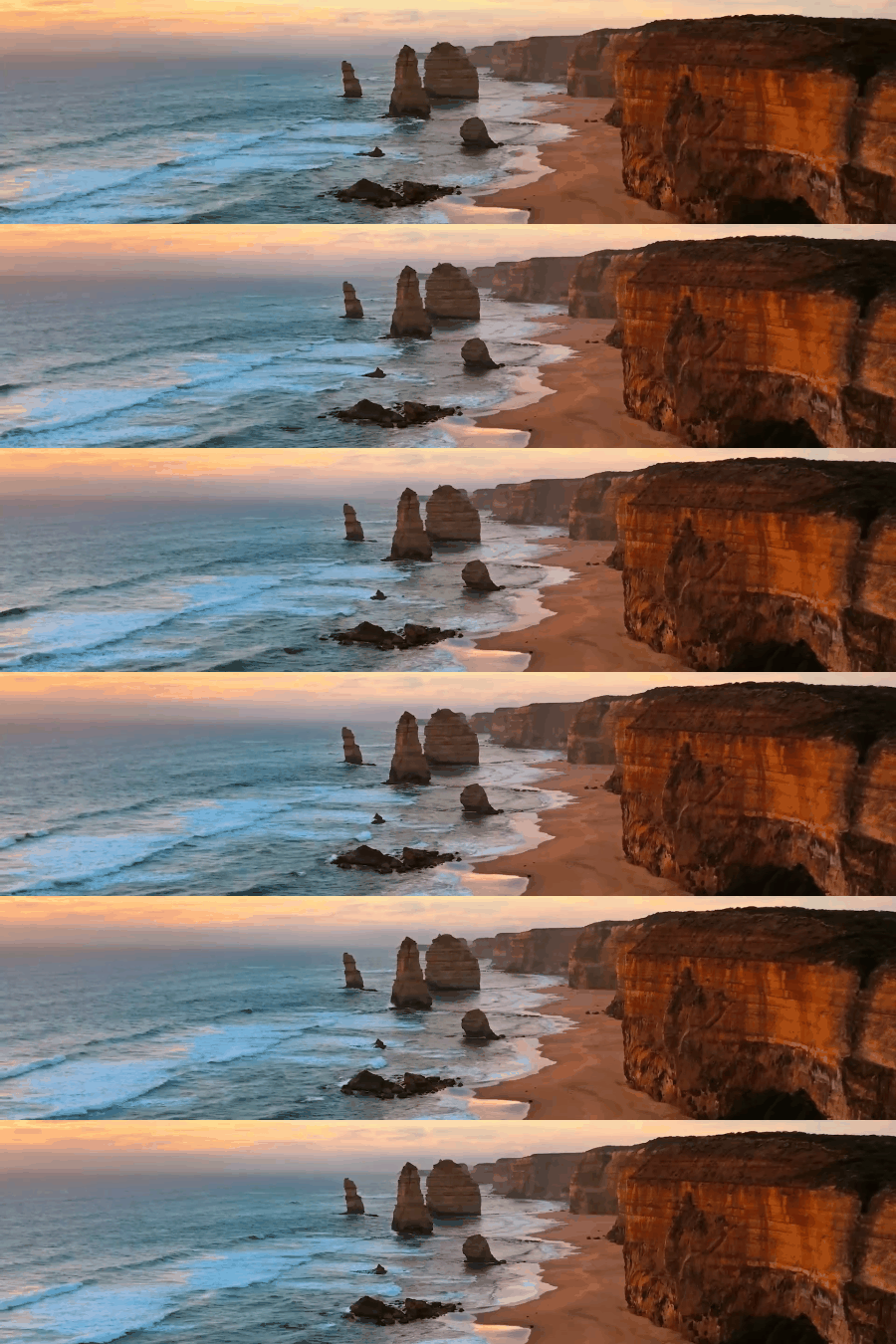
Using the age of microfossils within limestone, scientists show for the first time how Australia’s iconic Twelve Apostles were lifted and tilted out of the sea over millions of years

Published 24 April 2026
Nowhere else in the world can we see towers of yellow and grey limestone climbing 45 metres out of the sea.
The Twelve Apostles are like an enormous, temporary, natural art installation, which attracts more than six million visitors to the Great Ocean Road every year.
But despite their iconic status and popularity, there is still so much we don’t know about the Apostles’ age, how or why their distinct yellow and grey layers formed, or even when they emerged from the ocean.
Our research team has conducted geological fieldwork spanning five years in the Otway region, southeast of Melbourne, building on previous unpublished work by our co-author, Dr Cliff Mallett, in the late 1960s.
We have now determined for the first time how and when Australia’s iconic Twelve Apostles came to exist, finding that tectonic plate movements over millions of years lifted and tilted the giant structures out of the sea.
The sediment layers of the Twelve Apostles are among the world’s best-preserved and most accessible records of ancient climate and sea level changes from the Miocene Epoch (23-5 million years ago).
Sciences & Technology
A new thermometer for studying our past climate
The Miocene was a period of great change, where Australia was migrating north, creating space for the Southern Ocean to form and the Earth’s climate was transitioning from a warm to a cooler climate.
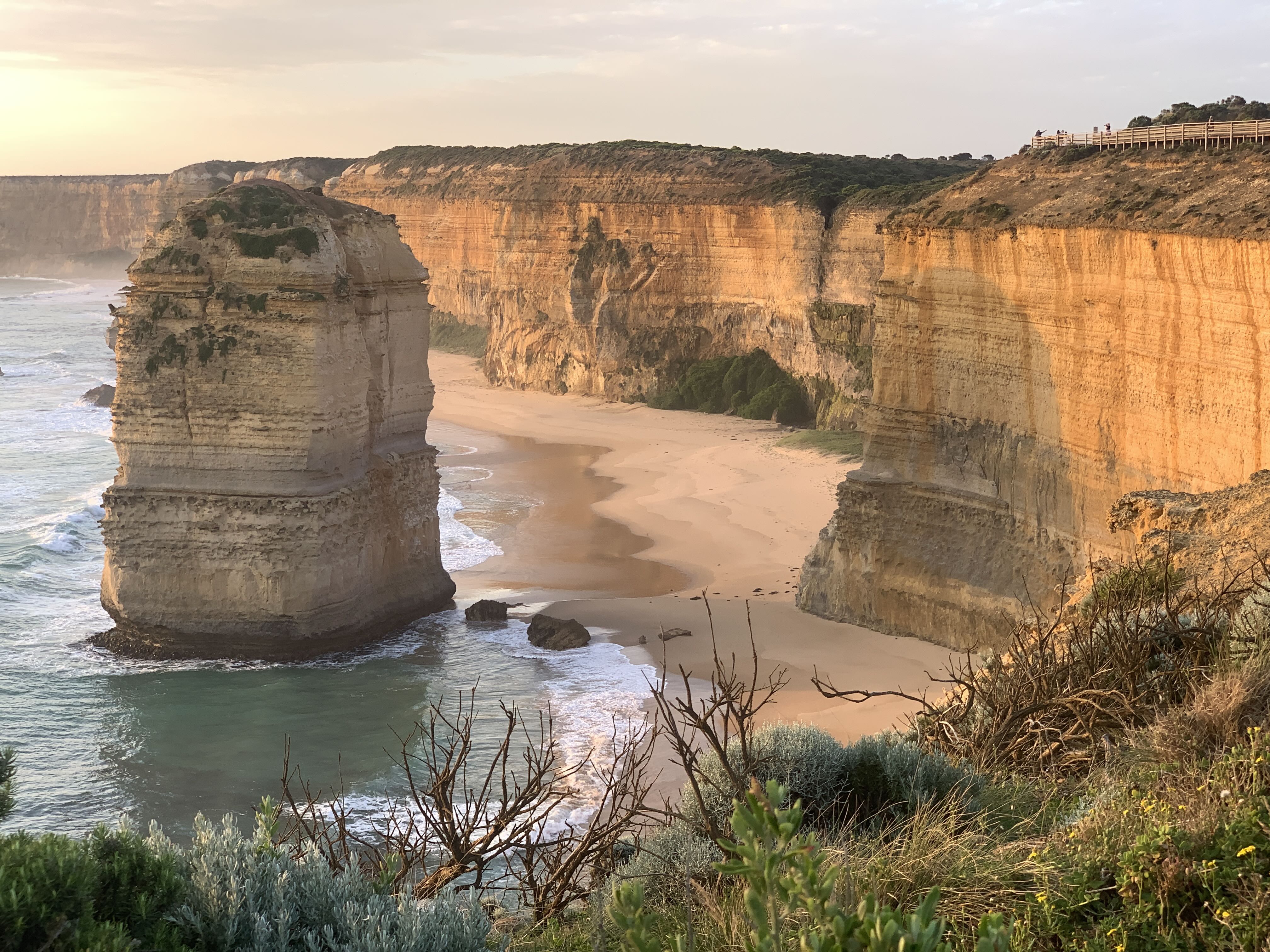
The yellow and grey layers of the Apostles record this Era in stunning detail and are comprised of Port Campbell Limestone, named after their location.
The yellow sediment layers take their colour from the amount of iron oxide (rust) that is spread throughout the limestone. And the grey layers contain large amounts of clay.
The whole region was once a shallow marine area, made of the same limestone.
Similar to tree rings or environmental time capsules, each layer of the giant Apostles is a record of changes through time, interpreted through microscopic fossils.
The fossils help us understand the history of Earth’s climate, tectonic activity, plants , and animals over millions of years.
Roughly less than 1/5th of a millimetre in size, these microfossils form much of the yellow and grey layers of the Twelve Apostles’ limestone.
When alive, they are one-celled organisms called Foraminifera, sometimes known as ‘armoured amoebae’ because they secrete a tiny shell or ‘test’.
Foraminifera float in the sea (as plankton) and live on the seabed (known as benthos organisms) alongside sponges, crabs, corals, clams and sea stars.
In fact, up to 760 trillion of these microscopic fossils make up an Apostle. That’s 760,000,000,000,000 of these critters.
We can get very precise ages for plankton forms in the fossil record because we know when they evolved and became extinct at particular times in the Earth’s history.
Their presence or absence allowed us to work out the ages of each of the layers of the Twelve Apostles.

The microfossil evidence revealed that the grey limestone layers to the east of the sea cliffs and Apostle stacks preserve a key time in Earth's history – when the climate was much warmer and seas were higher relative to today – from 13.8 to 14.1 million years ago.
This is younger than our preliminary research suggested.
Our earlier, unpublished research also suggested the yellow limestone layers at the top of the cliffs and sea stacks may have been as young as seven million years old, however, we found the microscopic fossils to more accurately date these layers to 8.6 million years.
This is exciting, as we now know precisely when the layers of the Twelve Apostles popped out of the ocean due to tectonic forces from 8.6 to 5 million years ago.

Sciences & Technology
When the Earth’s magnetic field flipped
The microfossil records also allowed us to date the youngest Apostle, the one that looks like a castle and is closest to the visitor lookout, at about 13 million years old.
With this new information, we can now use more detailed microscopic fossil and chemical studies to investigate how the Australian sea level and climate changed over thousands of years during this ancient warm period.
Studies that investigate change over relatively short geological timescales during warm periods in Earth's history are important, as they tell us how sea level and environments might be altered by future climate change.
If you look at the scenery around the Twelve Apostles, you will see the layers are not flat like layers in a cake; in fact, they are tilted a few degrees towards the ocean, and many of the layers in the region form large, wide arches called anticlines and troughs called synclines.
The cliffs near the Twelve Apostles lookouts and at Gibsons Steps (around 1km southeast of the Apostles) also show small fault lines; each preserves an ancient earthquake associated with this major tectonic event.
We used the layers to trace the major tectonic forces that buckled the limestone of the Twelve Apostles, causing them to tilt and break.
Sciences & Technology
What ancient pollen tells us about future climate change
While the limestones we have studied were gradually pushed above sea level over millions of years by shifting tectonic forces, it was only in the last few thousand years, after the last Ice Age, that coastal erosion exposed and shaped the towering rock pillars we see today.
We will continue to examine individual rock layers to reconstruct changes in climate, ocean conditions, and sea levels.
Our ultimate goal is to link the sediment layers with the timing of global climate events and understand how ancient processes continue to influence modern coastal erosion.
The research team also includes co-authors: Dr Cliff Mallett, University of Melbourne, Rohit Soman, Dr Gerald Auer, University of Graz and Professor Andy Herries, La Trobe University.