Sciences & Technology
Earthquakes that talk to each other


Running side by side down Australia's east coast, these two chains of volcanoes should have collided millions of years ago. New research reveals what's kept them apart

Published 18 September 2026
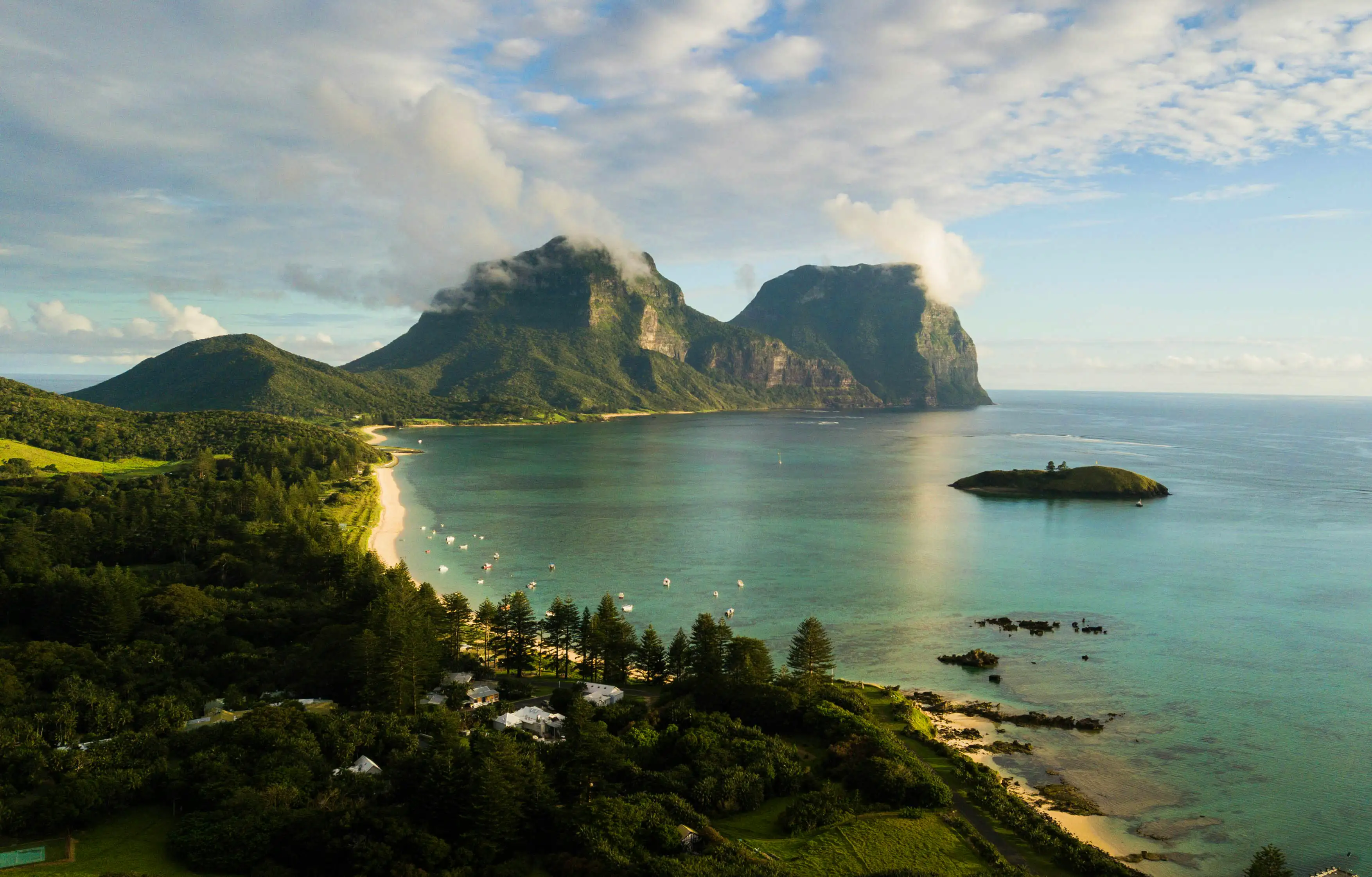
Lord Howe Island sits about 600 kilometres off the New South Wales coast, a crescent of rainforest and sea cliffs that draws visitors to its beaches and birdlife. Few people realise they are standing on the worn-down remains of a volcano.
And that volcano has a family.
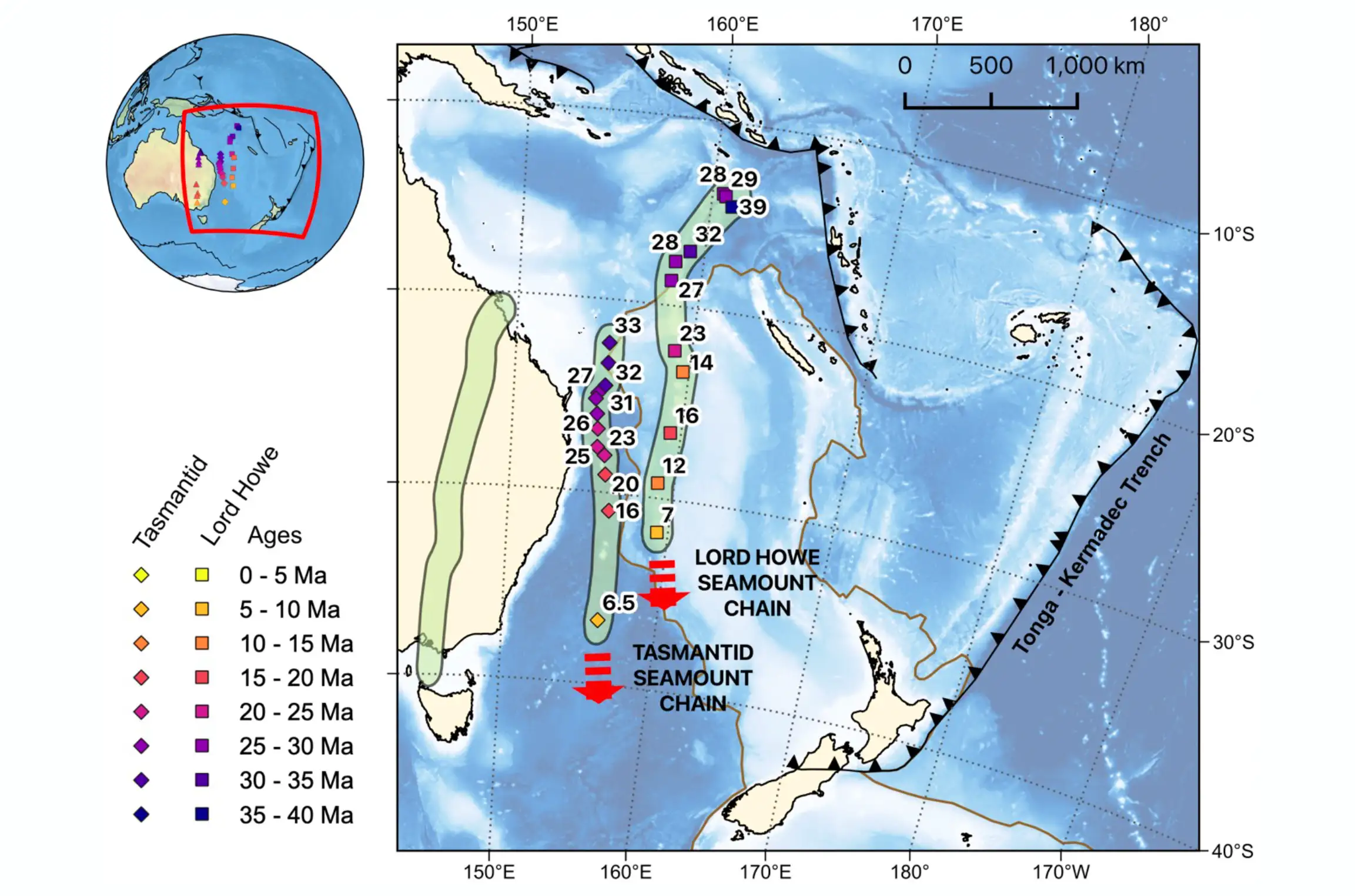
Lord Howe is one island of a chain of islands, called seamounts, off the east coast of Australia.
It’s the only island above sea level – the rest are submerged in the Tasman Sea, between southeastern Australia and New Zealand. Roughly 650 kilometres west runs a second chain, the Tasmantid seamounts, tracing almost the same path.
Two nearly identical chains of volcanoes, side by side, in the middle of a tectonic plate.
Now, for the first time, our research, published in Gondwana Research, can answer how this happened.
Sciences & Technology
Earthquakes that talk to each other
Most volcanoes occur where tectonic plates meet, but there are a few exceptions.
Hawaii is the most famous example. A plume of hot rock rose from deep inside the Earth, burning through the middle of the Pacific plate.
As the plate drifted overhead, the plume punched a new hole in it, then another, like a blowtorch under a moving sheet of metal.
This is exactly what the Tasmantid and Lord Howe chains look like. Both chains get steadily younger the further south you go, tracking the northward drift of the Australian plate over the past 40 million years.
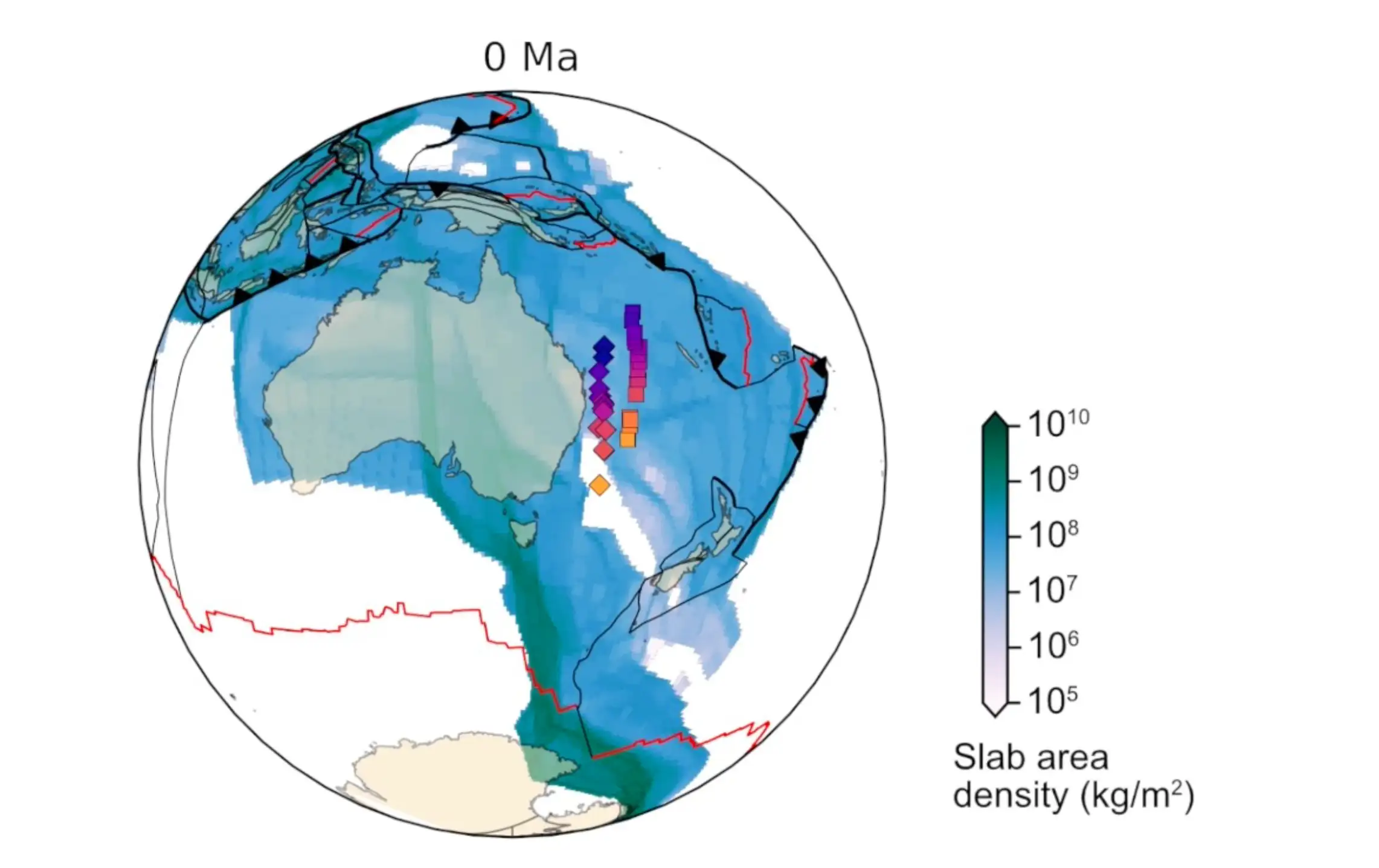
The trouble is the spacing.
Plumes this close don’t usually stay separate. In computer models, any two within about 1000 kilometres of each other tend to drift together and merge. But these remained side-by-side for 40 million years.
There is a second clue.
The lava from both chains is chemically nearly identical. But two unrelated plumes from separate patches of deep mantle should generally not produce the same rock.
It turns out the Lord Howe and Tasmantid seamount chains were never actually separate.
Sciences & Technology
When Central Australia slipped and trembled
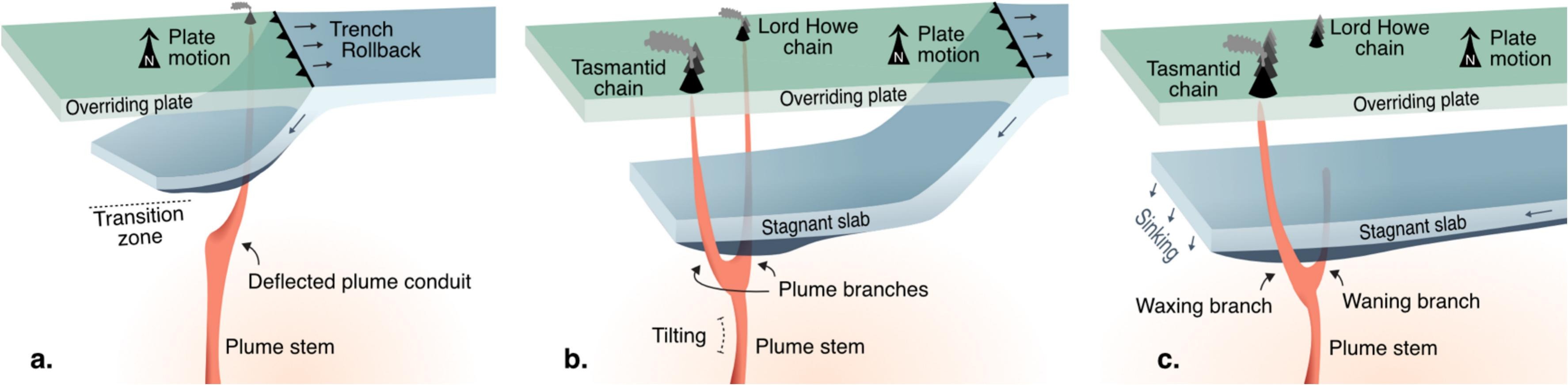
A single plume rises from close to the Earth’s core and runs into an obstacle, in this case, a slab of old ocean floor that sank at a subduction zone, then stalled about 500 kilometres down where the mantle abruptly becomes stiffer.
The plume cannot go through the slab, so it goes around it, escaping through gaps on either side. These two branches reach the surface and two chains of volcanoes form.
There are three separate lines of evidence that back this up.
The first is a simulation of the Earth’s interior, run by French geoscientists Maëlis Arnould and Nicolas Coltice.
The simulation was not set it up to reproduce the Tasman Sea, but as it ran, the plates and plumes evolved on their own.
As did the plume splitting, which reproduced the 650 to 900 kilometre spacing we’ve seen in the Tasmantid and Lord Howe seamount chains, replicating what happened over roughly 70 million years.
The second bit of evidence is reconstructing the last 200 million years of plate motion, mapping where old seafloor sank beneath the Tasman Sea.
It reveals a ribbon of slab material with gaps on either side, exactly where the model says each branch would rise.
The final clue is in the chemistry.
The lead isotopes in both chains carry a unique ‘fingerprint’ that takes more than a billion years to develop. This is far too long to have come from the nearby subducted slab, which has only been down there 60 million years.
It came from deep in the mantle and both chains carry it.
This evidence, taken together, confirms one plume, two branches.

Sciences & Technology
Tiny 'time capsules' reveal the true age and origins of the Twelve Apostles
One of the most interesting discoveries is that we can predict what will happen to the Tasmantid and Lord Howe seamount chains millions of years into the future.
In the simulation, the branching does not last forever.
As the slab obstructing the plume sinks deeper into the Earth’s mantle, one branch is uncovered and becomes dominant, while the other shuts down.
The eruption volumes also reveal a decline along the Lord Howe seamount chain over the past 23 million years or so, while the youngest Tasmantid volcanoes are getting larger.
So our research suggests that the Tasmantid chain becomes the main conduit and Lord Howe will eventually stop growing.
Geological hotspots are one of the tools we use to work out how continents have moved, because a plume stays roughly fixed while plates slide over it.
If a chain can be one branch of a plume that shifts as it encounters subducted slabs, then counting chains is not the same as counting plumes.
It also changes the picture of the deep Earth.
Plumes are usually drawn as straight vertical pipes, but in this case the plume is dynamic and evolves as it encounters obstacles within the Earth’s mantle.
The same mechanism may explain other closely spaced chains, like the one in Yellowstone in the US, and some hotspots that look ordinary today may have branched in their past.
Seismic images beneath the Tasman Sea are still fuzzy, so we need higher resolution images to discern each of the branches.
We also need more rock samples from these underwater volcanoes to better constrain the geochemistry of the eruptions.
An island like Lord Howe may feel permanent, but it's just the visible tip of something produced deep towards the Earth's core, which is still shifting and moving. The rock beneath our feet is never as settled as it seems, and there's still plenty down there we're yet to discover.
Co-authors on this research include: Maria Seton, Simon Williams, Joanne Whittaker, Rebecca Carey, Maëlis Arnould, Nicolas Coltice, Angus Rogers, Saskia Ruttor, Oliver Nebel and Christopher Gonzalez. The work was funded by the Australian Research Council, the Australian Antarctic Science Program, the New South Wales Department of Industry and AuScope, with computing from the National Computational Infrastructure and ship time from the Marine National Facility aboard the CSIRO Research Vessel, Investigator.